A little less than two weeks ago, on 10/4/15, I removed the supers from my strong hive, and inspected both hives. The smaller, weaker hive was still plugging away, but didn't seem to have made much progress. In hindsight, I should have been feeding this hive more during the season to try to encourage them to build out the comb, and I also could have given them a boost with brood and frames from the stronger hive.
At the same time that I performed these inspections, I put feeders on both hives, to help them improve the stores of honey in the hive bodies.
On Monday after work, we noted that the bees were really upset about something. Flying like crazy, collecting in weird areas, such as on the hood of a car, and on the neighbor's swing. It was very strange, and there were a lot more dead bees in front of the hive than there had been the day before. This was concerning, but I couldn't say for sure if it was robbing. So I made sure the entrance reducers on each hive were in place, and called my Dad. He listened to all the "symptoms" and said that maybe they'd gotten into something that the colony didn't like. If bees come back to the hive smelling like a chemical that the colony really doesn't like, they will start to kill off the foragers. At this point, I didn't know what else to do except wait.
In the meantime, while I was waiting, I asked our nextdoor neighbors, and they explained that they used a plant food, but they had used it many times before and none of us have ever seen the bees react this way. I ruled this out, but I still believe the bees got into something, somewhere that caused a lot of problems.
On the afternoon of Sunday 10/11/15, after returning from a weekend road trip, I checked the bees to see if they needed syrup, and found the feeder being robbed by another colony of honeybees through the top entrance, and the lower, front entrance was being robbed by yellow jackets! When I investigated further, I found countless dead bees inside the hive, on the screened bottom, and determined there is not living colony left in the hive. All the activity in the hive was from robbers.
After another call to my Dad, and a couple days and nights of thinking about it, the reality still has not completely sunk in. My Dad suspects the colony was poisoned by something, and he said that many pesticides that homeowners treat with, such as Sevin, are notorious for situations like this. The bees live long enough to bring the chemicals back to the colony, and they all perish. I suspect this situation is more common in urban areas, and that the chances of this happening to me are much higher because of where I live.
I wish I could say for sure that I'll "get back on the horse" and order a package in the spring, but if there is a high likelihood that it could happen again, and I don't have any way to prevent it, I'm really not 100% sure.
I had no idea that I'd be so emotionally involved in a group of intelligent insects, but my heart is aching as though I've lost a pet.
Tuesday, October 13, 2015

Monday, June 15, 2015
It's Only Mid-June
And I haven't seen any signs that the ladies in Rose will slow down for much of a break!
When I started this season, in my storage room, I had a total of four empty supers. I had one super that was between 25% and 50% drawn out, and the remaining supers were all empty foundation. In early April, before leaving town on a vacation, I put one super on (the one that was partially drawn) just in case some flowers opened while I was gone. And two weeks later, I wish I had put two on at the beginning. And so the season has gone.
Now I have learned a bit from those mistakes, because I'm checking more frequently, and making sure they aren't running out of space too fast. About 4 weeks ago, the first (partially drawn) super was full, and they were drawing out the second. So I put two more on.
The last couple of weekends when I've checked them, they've been a bit stagnant, but I wasn't worried, I'd take 2 full supers for the season and be ecstatic with those results.
I checked again yesterday, expecting to see more of the same. They have capped the first and are in the process of capping the second, and the third and fourth are more than 50% drawn. Below are a couple pictures of some of the capped frames:

Look at this beautiful honey:

This frame is almost completely capped:

This side of the frame is only partially capped:

My Dad sent me a package last week with 3 more supers worth of frames, hoping to buy me some more time before I'd need an extractor. Well am I glad he did, and yet, if the intermittent rain and sun keep up, I'll need one in 4 to 6 weeks anyway.
When I saw how much progress had been made in just one week, I sort of freaked out just a bit, and ran into the house to pull out 2 more supers of empty foundation that my Dad sent. We've officially moved into step ladder territory. I think I may need to start lifting weights, too :)


Below are some more pictures, just for those who like looking through the pictures, and since I haven't been posting much lately:


I guess I Was Wrong
About a month ago, I introduced my daughter to our new queen.

Then I hung the cage containing the new queen inside Lavender. I checked after two days, and she was still in the cage. A very good friend of mine put on my extra hat and veil to take some pictures and catch a peek inside.

A couple days later, I checked again, and the queen and all her attendants were dead inside the cage. That night, I called my Dad, and he looked back through my pics on the blog. He explained that the laying pattern I was seeing was just spotty because queens in the spring don't always lay consistently, and the pattern when they start out in the spring can sometimes just be off.
So I was apparently wrong, there had been a queen in the hive all along, and it just wasn't laying in a nice even pattern like I'd anticipated.
Over the past four weeks, during weekly inspections, I've verified this by finding new brood throughout a couple frames. Finally, the laying pattern is what it should be, and is finally looking better. Now, with time, I expect the numbers in the hive will start to increase.
On a better note, Rose is excelling (may have excelled even more if it hadn't swarmed at least once, maybe more) and already has a lot of honey. I'll go into more detail about this in my next blog post.
But yes, you did read correctly, I'm fairly certain that Rose has spawned at least 1 or 2 swarms, because I didn't give them enough space fast enough. Upon inspection four weeks ago, I spotted empty queen cells hanging off the bottom of the frames in the top hive body, which is a tell tale sign of swarming. I'm definitely learning something new every day, and I'll apply what I've learned to next year.
For other beekeepers out there, I'd say the one thing to take away from this post is patience. If I had taken more of a wait and see philosophy with Lavender, and just been patient, I wouldn't have lost a perfectly good queen. I learn something new every week when I check on these beautiful ladies!
Sunday, April 26, 2015
The Little Hive That Could(n't)
Poor Lavender just hasn't gotten over this string of bad luck, at least not yet anyway. I've just placed an order for a new Italian queen for the smaller, weaker hive.
I wasn't 100% sure last week, when I thought they were too buzzy to be "normal", but I confirmed this evening, upon inspection, that Lavender is (again) queenless. If you're one of my 2 or 3 regular readers, you may remember that I purchased a queen for Lavender last August after trying, unsuccessfully to help them raise a queen by giving them a frame of fresh eggs.
At that time, giving them some eggs at least helped their population and straightened out a laying worker problem. So far, this time around, I don't believe I have a laying worker, at least not a very active one, because there isn't a lot of drone comb.
Tonight, it was too late in the day, and I was in a hurry, so I didn't take any pics, but there wasn't anything to photograph anyway. In fact, that is the problem, other than pollen and honey stores, there is nothing in the comb. At this point in the season, it is very, very bad to not have any new brood, and if I don't turn things around fast, it could mean the end of the colony. They're working so hard to collect nectar and store honey, and the lifespan of the honeybee is way too short this time of year.
Tonight, if I had more smoker fuel, I would have preferred to move a frame or two from Rose to Lavender, but luck was against me. In addition to ordering a queen, I also ordered some smoker fuel, because I am completely out.
I should receive the new queen on Tuesday, but won't have smoker fuel to install the new queen for a couple more days. Since I don't want to wait that long to install her, I guess I'm going to have to get creative about what to burn, that creates a smoke that's as cool and white as possible, and that I already have around the house. Any suggestions?
Saturday, April 18, 2015
The Start of Year 2
Spring is definitely in full swing. Both Rose and Lavender are active and doing all they're supposed to do. Dandelions are open, as well as a lot of other spring flowers, and everything is green and growing. So far we have gotten a good mix of rain and sunshine to make conditions perfect for an early nectar flow.
I inspected both hives, and I'm very pleased with the laying pattern I found while inspecting Rose.
I'm not entirely sure what's wrong with Lavender, but I'm not happy with what I saw. The laying pattern isn't consistent, and there are occasional extremely large cells (seem too long to be drones, but do not hang vertically like a queen cell).


Any thoughts?
Sunday, March 15, 2015
Flowering Trees
While observing the hives yesterday, I noticed a bee or two with pollen as they re-entered the hive. Here in southern/central Indiana, we must have some trees flowering.
Rose seems very strong, and has cleaned out a lot of dead bees since last week. Cleaning house is a good sign.

Rose is also taking a lot of syrup, because both pint jars were empty when I checked the feeder.
Lavender has only consumed about 1pint of syrup, but they were still moving pollen in, and while they don't seem to be as strong as Rose, they're still holding on.
Neither hive seems to be eating much of the pollen substitute I gave them last week, but I'm guessing that's because they have natural pollen to use for raising brood.
Hopefully either today or next weekend, I'll be doing some work on Lavender to get the colony moved out of the super. I'll try to get some pictures of that process when I do.
Sunday, March 8, 2015
Spring?
We are so thrilled, and so very lucky, to announce that we seem to have a 100% survival rate! If they don't make it now, it will most likely be due to starvation. So today I fed each hive. In each feeder box, there is quart of one-to-one syrup and a large, homemade pollen patty, made from Bee Pro pollen substitute mixed with some extra one-to-one syrup.


Saturday, August 16, 2014
Long Over Due Update
August 2, 2014
Approximately two weeks after moving the frames of brood and eggs from Rose to Lavender, I opened up the hive to check on Lavender's queen raising progress. I found several queen cells, one of which was open on the end (essentially uncapped). All the others I found had been broken through the side, and some still had dead larvae inside the broken cells. After some discussion with my Dad, I learned that these were all good signs, but I hadn't found fresh eggs, which is the only guaranteed way of knowing you have a new queen. The following week, my parents happened to be coming for a visit anyway, so my Dad just said to wait another week to check them again when he was here.
August 9, 2014
We smoked Lavender, and opened it up, and my Dad immediately stated that they still didn't have a queen. He could tell by the loud buzzing sound coming from the hive. Most likely, the eggs I gave them were too old, and they couldn't raise a viable queen from any of them. While inspecting, we determined the colony wasn't using the original super that I started them in when I caught the swarm, so we removed that.
Then we smoked Rose to search for some new eggs to put another frame into Lavender and repeat the process again. However, without us realizing it, the weather began to turn cloudy and overcast. We took off the supers (the lowest super is full of honey BTW, my Dad predicted around 25 lbs!) and inspected just about every frame in the top hive body. None of the frames had anything but capped brood and honey. Before we had time to inspect the lower hive body, my Dad was stung 4 or 5 times, and we decided to close it up and come back again another day. As we closed up both hives, we moved the empty super that was on the bottom of Lavender, and put it on top of Rose, so Rose is up to 3 supers.
Within the next 2 days, we decided to order a new queen from Walter T. Kelley. We drove down to Clarkson, Kentucky on Monday, August 11, 2014 to pick it up and put the queen's cage into the hive that evening when we got back.
August 14, 2014
We inspected Lavender again to check on the queen's cage, and as soon as we opened it, the bees were much more settled than the last inspection. My Dad could tell instantly by the sound they made that they were more comfortable because they had a queen. It was a subtle change, and I wouldn't have noticed the change in their sound if he hadn't pointed it out. The workers in the hive had eaten far enough through the candy so they would have had her out by the end of that day. But we didn't want to have to go back in to remove the empty queen's cage later, because the weather was getting unpredictable. And we wanted to remove the cage as soon as possible to prevent them from building burr comb. So my Dad removed the screen from the queen's cage and released her and the attendants into the hive. I am kicking myself as I write this, because I should have taken some pictures during the last few days, especially of this task. The queen left her cage, and first climbed around on my Dad's hand before climbing down onto a frame.
At the same time, since we had the smoker burning, we checked Rose again, and the bees are actively working on the third super that we put on just 3 days before.
August 15, 2014
The bees in Rose were soooo active, I was amazed how many bees were foraging (coming in and out). My Dad predicted that the hive probably brought in at least 2 pounds of honey, just that day! Good thing we put the 3rd super on. I also was happy that we have enough fence around the hives to force the bees to fly up before flying to the flowers where they're collecting nectar, because that many bees flying in and out with a low flight pattern would make it hard for us to even be in our yard on that busy of a day.
August 16, 2014
Lavender was long over due for a refill of syrup in the feeder, and I added a 4th super to Rose. Exciting times in our backyard lately.
Still to come in the next few weeks and months:
~ Confirmation of eggs from the new queen in Lavender - it's getting late in the season, so they really need to take off fast and get to increasing their worker numbers to fill 2 hive bodies for the winter.
~ Taking supers off Rose to extract honey. I never thought this would happen the first season, but it's a whole new step for me, since I never learned this part from my Dad in person. He's coming for another short visit though, for a wedding that's a few hours away, so I am going to try to get what I can done before he gets here.
~ Winterizing - getting the hives ready for winter is important, and every beekeeper has different ideas for how to do it.
~ Assisting and mentoring a first time beekeeper
Tuesday, July 29, 2014
A New Young Queen?
We'll find out if Lavender has one soon.
After a discussion with my Dad on Sunday 7/20, I weighed the numbers, or the dates, I suppose. Under the best possible circumstances, if I bought a new queen for the hive, I might be able to have a new laying queen settle into Lavender by at most a week sooner than if I provided the colony with eggs from Rose.
My Dad explained that a laying worker complicates things, and the bees in the colony might not accept a new queen. If they raise a queen, it's almost a guarantee that she will be accepted and cared for. So, with that potential setback on the back of my mind, I decided to switch some frames between the hives to give Lavender a frame containing fresh eggs and also a frame of brood (young bees) from Rose.
Remember the photos from my last post? I've included one here, but I've circled in red where you can see larger cells that have been drawn out differently:

These are the queen cells that the colony has been drawing out in hopes that one of the eggs laid by the laying worker would be fertile and grow a new queen. Instead, when the bees realized it was simply another drone, they stopped drawing it out (a true queen cell should be even longer - I'll try to take another picture the next time I have the hive open, if I can find one).
The bees will take a fresh egg (or most likely at least a couple, maybe more) and move them into these drawn out cells. They'll finish drawing them out to the right length, and feed the larva royal jelly and these will become supersedure cells. A swarm cell is done in a similar fashion, but wouldn't usually be found in the middle of the frame. It would be found hanging from the bottom of a frame.
I was concerned that I would create more work for the bees, asking them to grow additional supersedure cells, given that there were already several built inside some of the frames. However, my Dad explained that the bees will choose the egg (or eggs) they feel are best for raising a queen, and move them to the cells that have already been drawn out.
Lavender has been slowly declining, with more bees dying off, and only drones hatching in the hive. So I also pulled one frame of brood from Rose that had bees ready to hatch from it. In fact, I could see the new bees beginning to emerge from a few of the cells. This will help to keep the colony alive a couple more weeks until the new queen is laying.
For now, I can see some bees are out foraging when I watched the outside today, and that's a good sign. When I checked the syrup level in the feeder this evening, there were a lot more bees in the top working around the jar, and this seems to also be a very good sign.
As I am typing this post, it's been about 9 or 10 days since I switched the frames to help Lavender again. In a couple more days, I'll check the hive again, and hopefully have good news about it's status.
After a discussion with my Dad on Sunday 7/20, I weighed the numbers, or the dates, I suppose. Under the best possible circumstances, if I bought a new queen for the hive, I might be able to have a new laying queen settle into Lavender by at most a week sooner than if I provided the colony with eggs from Rose.
My Dad explained that a laying worker complicates things, and the bees in the colony might not accept a new queen. If they raise a queen, it's almost a guarantee that she will be accepted and cared for. So, with that potential setback on the back of my mind, I decided to switch some frames between the hives to give Lavender a frame containing fresh eggs and also a frame of brood (young bees) from Rose.
Remember the photos from my last post? I've included one here, but I've circled in red where you can see larger cells that have been drawn out differently:
These are the queen cells that the colony has been drawing out in hopes that one of the eggs laid by the laying worker would be fertile and grow a new queen. Instead, when the bees realized it was simply another drone, they stopped drawing it out (a true queen cell should be even longer - I'll try to take another picture the next time I have the hive open, if I can find one).
The bees will take a fresh egg (or most likely at least a couple, maybe more) and move them into these drawn out cells. They'll finish drawing them out to the right length, and feed the larva royal jelly and these will become supersedure cells. A swarm cell is done in a similar fashion, but wouldn't usually be found in the middle of the frame. It would be found hanging from the bottom of a frame.
I was concerned that I would create more work for the bees, asking them to grow additional supersedure cells, given that there were already several built inside some of the frames. However, my Dad explained that the bees will choose the egg (or eggs) they feel are best for raising a queen, and move them to the cells that have already been drawn out.
Lavender has been slowly declining, with more bees dying off, and only drones hatching in the hive. So I also pulled one frame of brood from Rose that had bees ready to hatch from it. In fact, I could see the new bees beginning to emerge from a few of the cells. This will help to keep the colony alive a couple more weeks until the new queen is laying.
For now, I can see some bees are out foraging when I watched the outside today, and that's a good sign. When I checked the syrup level in the feeder this evening, there were a lot more bees in the top working around the jar, and this seems to also be a very good sign.
As I am typing this post, it's been about 9 or 10 days since I switched the frames to help Lavender again. In a couple more days, I'll check the hive again, and hopefully have good news about it's status.
Sunday, July 20, 2014
Laying Worker Bee
Just when I think I've got something figured out, and the little hive, Lavender, can do her thing and just grow and improve, we hit a bump in the road. But I can honestly say that I'm learning something new every step of the way. I have previously heard of and read about a laying worker, but never imagined I'd encounter one so soon in my beekeeping career. A laying worker bee is generally found when a colony doesn't have a queen, and also doesn't have any fresh eggs to raise a new queen among the brood (supersedure cell).
While inspecting both hives today, I found the larger hive, Rose, to be going along great and doing well. Just plugging along and starting to build out and fill the lower super.
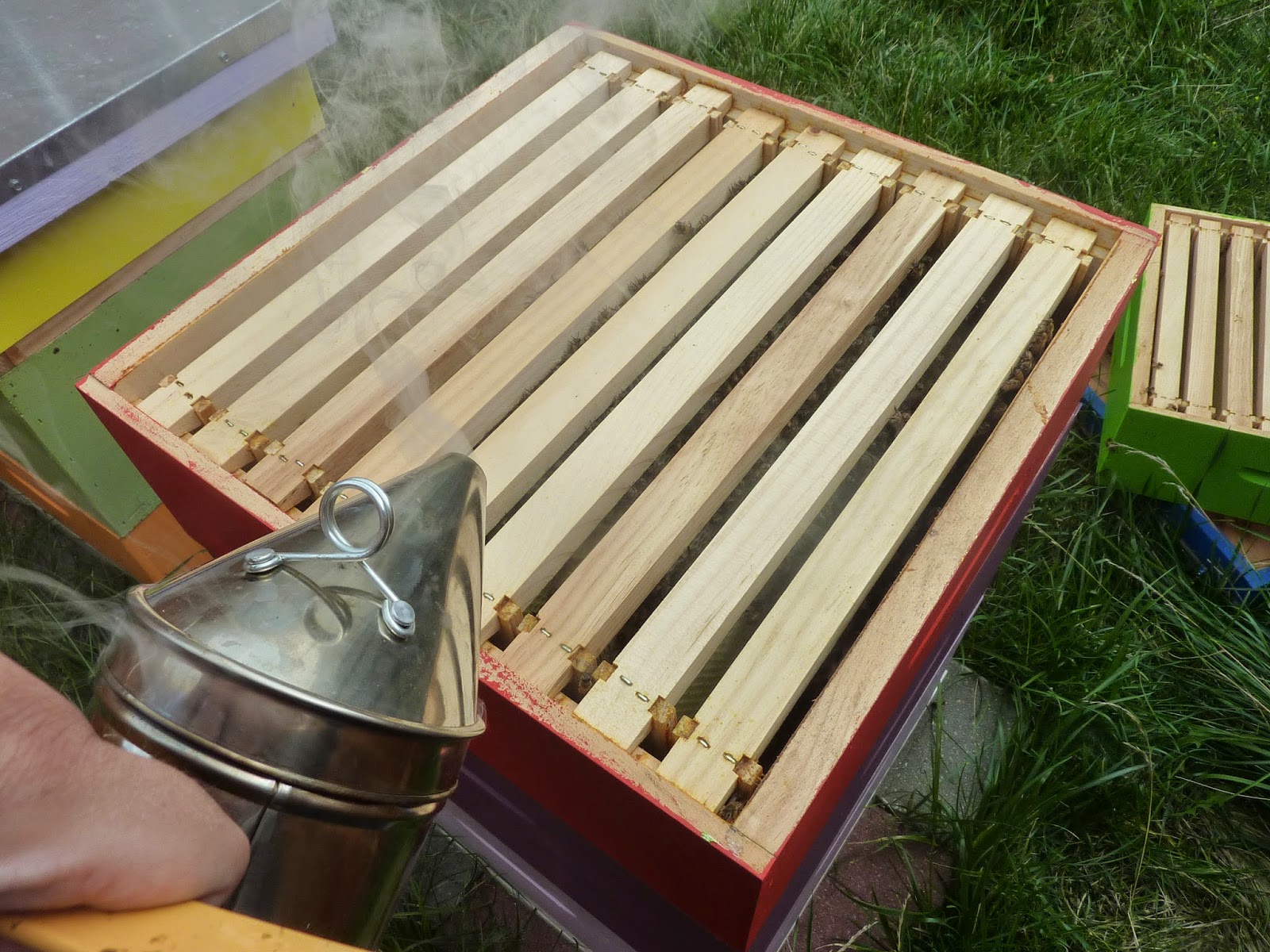
At the request of an old friend, I took my camera with me, to snap a few pictures. Here are some general photos I took. The first is a picture, of the super that Rose is currently working on. In the background, you can see the other super that goes on top of this one.

In this next photo, you can see in the top right hand corner where the comb (described above) is more visible. Some of the bees in this photo are building out more comb, and the ones with their heads in the cells are slowly filling the cells with nectar.

This is just a close up shot of the bees that were clustered around the bottom of the super frame.

I'm glad I had the camera with me, and I owe my friend a big thanks. If I hadn't taken it with me to take some general photos I would not have been able to document and explain what to look for to "diagnose" a laying worker.
In this case, I may never know why they no longer have a queen. It may be that she died. She may have been an old queen that came with the swarm from their original hive, and queens are only good for a couple years, usually 3 at the most. She may have been deemed not good enough by the colony, and they killed her, but whatever the reason, I don't believe they have a queen anymore.
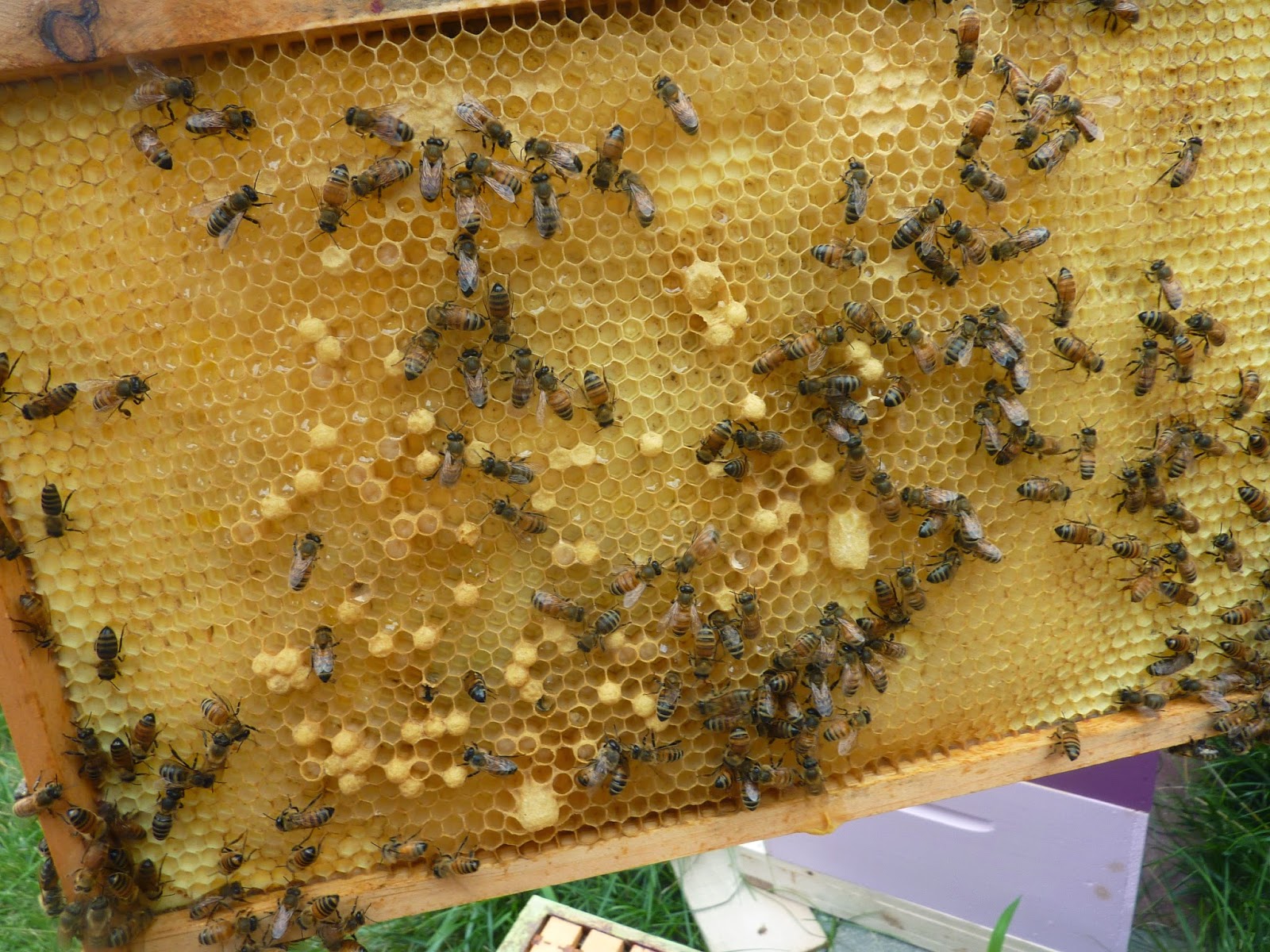
Two weeks ago, when I gave Lavender a frame of brood from Rose, I checked and saw fresh eggs laid in Lavender's hive body, and celebrated it a bit, thinking the queen was settling in well. I now know better, because any new brood cells (and there aren't too many) are all drone cells. A laying worker doesn't have the physical ability to breed and carry sperm for fertilizing her eggs, but she can still lay the eggs. Unfertilized eggs will only ever grow into drone bees. So this colony is slowly going to die off without a queen.
In the following pictures, you can see the very spotty brood (not much has been laid) and each cell that's capped is rounded up a bit (rounded, capped cells are drones & flat, capped cells are workers).



While inspecting both hives today, I found the larger hive, Rose, to be going along great and doing well. Just plugging along and starting to build out and fill the lower super.
At the request of an old friend, I took my camera with me, to snap a few pictures. Here are some general photos I took. The first is a picture, of the super that Rose is currently working on. In the background, you can see the other super that goes on top of this one.
This next picture is one of the super frames that the hive is working on. The whiter section of the frame is where they've built out some comb, and the yellower tinted areas are empty foundation.
In this next photo, you can see in the top right hand corner where the comb (described above) is more visible. Some of the bees in this photo are building out more comb, and the ones with their heads in the cells are slowly filling the cells with nectar.
This is just a close up shot of the bees that were clustered around the bottom of the super frame.
I'm glad I had the camera with me, and I owe my friend a big thanks. If I hadn't taken it with me to take some general photos I would not have been able to document and explain what to look for to "diagnose" a laying worker.
In this case, I may never know why they no longer have a queen. It may be that she died. She may have been an old queen that came with the swarm from their original hive, and queens are only good for a couple years, usually 3 at the most. She may have been deemed not good enough by the colony, and they killed her, but whatever the reason, I don't believe they have a queen anymore.
Two weeks ago, when I gave Lavender a frame of brood from Rose, I checked and saw fresh eggs laid in Lavender's hive body, and celebrated it a bit, thinking the queen was settling in well. I now know better, because any new brood cells (and there aren't too many) are all drone cells. A laying worker doesn't have the physical ability to breed and carry sperm for fertilizing her eggs, but she can still lay the eggs. Unfertilized eggs will only ever grow into drone bees. So this colony is slowly going to die off without a queen.
In the following pictures, you can see the very spotty brood (not much has been laid) and each cell that's capped is rounded up a bit (rounded, capped cells are drones & flat, capped cells are workers).
I was able to come to this conclusion after a discussion with my Dad about what I saw (he was the one who suggested if all the capped brood is drone, that it's almost definitely a laying worker). His first suggestion is to give them a frame of capped brood and a frame of fresh eggs from Rose. Since talking with him on the phone, I haven't gone back out to switch the frames yet. I'm debating whether or not to buy a new queen from Walter T Kelley for the colony, to get a queen in there and laying sooner. I'm sad that this smaller hive has had such a huge setback, and now torn about how to fix it. At any rate, I can't wait very long to decide on a course of action, so I'll have another update soon.
Hope all of you readers enjoy the extra pictures in this post :)
Hope all of you readers enjoy the extra pictures in this post :)
Wednesday, July 9, 2014
A Little Help from One Hive to Another
July 4, 2014
I opened up both hives, to assess their status, and make sure Rose wasn't expanding any faster and requiring anymore supers. I also wanted to check on the activity level of Lavender to assess how much they were working in the hive body and moving out of the lower super.
Rose was doing very well, and seemed to have just started working in the 1st super just a bit. They have done a very nice job of filling the frames in the hive bodies, but just to make sure they would completely fill the outermost frames, I flipped them. If you imagine all 10 frames numbered from 1 to 10, I pulled out 1 and 10 and flipped them so the outside faces of each frame are now turned in.
Lavender still seems to have very low numbers, and as I look back at the dates here in my records, I know it will still take some time to build up the brood (and for the brood to hatch). So in an effort to give them a boost, I traded a frame from Lavender with a frame from Rose. I looked through all the frames in the upper hive body of Rose, and chose what appeared to have the largest amount of capped brood, though still only about 50% of the cells were capped. I knocked off all but half a dozen bees or so, and placed it into the middle of Lavender. Then I took an empty, foundation frame from the outside of Lavender, and placed it on the outside of Rose. I did this at the recommendation of my Dad, and he has assured me Rose will barely notice. I hope I also helped Lavender instead of creating more work for them.
July 7, 2014
I checked on the syrup level in Lavender when it was almost dark in the evening, and their jar was nearly empty. I took them a new jar, and now I'm working on a new batch of syrup, since I'm just about out (and the syrup I have been using has gotten a bit too old). It was made in early May, so it has lasted a while in my refrigerator.
As a side note, when starting a new hive, and through the early spring if you're feeding a weak hive that's wintered over, you feed them a syrup that is a 1:1 ratio of sugar to water. The recipe that I got from my Dad is as follows:
Bring 20 cups of water to a full rolling boil in a large covered pot. Turn off the heat and add a 10 lb bag of sugar. Stir the whole pot until all the sugar has dissolved. Then add 1/8 tsp of sea salt. When the liquid has cooled, my Dad then adds maybe about a tsp of lemon juice.
I split this recipe in half, and also leave out the extra steps of sea salt and lemon juice. He said they aren't crucial, but he likes to add them for various reasons. And now that I've reminded myself of the recipe, I'm off to heat some water and make another batch.
Edit:
I forgot to mention, this syrup recipe makes approximately 2 gallons (I think just a bit less than 2) and requires a VERY large pot. I don't have a pot large enough in my kitchen, so that's why I split the recipe in half. Also, if you only have one or two hives, and you won't use up the syrup relatively soon (within a few days, or maybe if you push it, a week at most) refrigerate the syrup in jugs (recycled milk or water jugs) to store it for longer. My husband makes a lot of homebrew, and enjoys an occasional growler from various local breweries, so I borrow his empty, clean growlers to store syrup.
Supers!
June 25, 2014
I finally decided to follow another blogger's lead, and name my hives after flowers. I've chosen Rose for the larger, older hive that I started from a package in May. I added two supers to the top of Rose, and took the feeder off. I laughed about it after, comparing it to taking off the training wheels from a bicycle for a child :)
The name I've picked for the smaller hive that was started from a swarm is Lavender. Because I already had my smoker lit, and was out there sweating like crazy anyway, I decided to check for eggs and see how the smaller colony was doing. In the hive body, that I only added 5 days ago, there were already eggs and larva of varying ages. This means the queen is doing her job and they are moving right along into the larger space. I didn't feed them any more syrup, because they still had 1/2 a jar.
In other news, I've been reading more about Colony Collapse Disorder (CCD) and what real research has actually been published about it's causes. It seems like CCD is now used interchangeably to describe the decline in bee colonies overall. Enough people around the country, celebrities, politicians, and the like, are taking notice, and making this news topic "sexier." CCD is a term used a lot in the media, and it gets the attention of average citizens around the country.
This article has a lot of the basics and some of the details covered well:
http://www.takepart.com/feature/2014/06/20/what-is-killing-bees
I also find this link very interesting. The President has finally taken notice and decided the US should start to do something about the problem.
Hope everyone has a terrific 4th of July and finds a festive way to celebrate our Nation's Independence!
Sunday, June 22, 2014
A New Home for Our Swarm
June 15, 2014
Checked the hives and added 12 ounces to the feeder jar for the new hive. It sure is eating a lot, but I suppose that's good because they have a long ways to go to build up their numbers and fill two hive bodies this season. Unfortunately, the "wild" swarm was relatively small, compared to what I would have liked it to be this late into the season.
June 18, 2014
I was still feeling very under the weather from food poisoning, but my husband reminded me that I should at least check the syrup levels in each hive. I'm glad he reminded me, because I gave each hive additional syrup. The older, larger hive took about 8 ounces, and the new hive took another 12 ounces. There must not be as much to forage on (we haven't seen much, if any, rain the last couple weeks).
June 20, 2014
We received the new hive body from my Dad in the mail today. We had a lot of afternoon rain, but after it stopped and the ground dried out some, my husband and I finally got the smaller colony into their new home. We first moved our larger hive over, re-positioned some of the paver bricks (after purchasing a few more) and then put together a proper hive for the second colony. We were a bit nervous, because after smoking this hive, it got pretty loud, and as we moved it, a lot of the bees left the hive and were flying around us. But once the hive was all settled in its permanent location, they settled back down within a few minutes. Both the older hive and the newer one now rest in slightly different spots only a few inches from where they each were previously.
Here is a picture of the two hives (my camera skills with a smart phone need some improvement):

I am very proud of my husband. This particular day, working on the bees required a lot of help from him to actually move the larger hive over and re-arrange the bricks. And I'm super proud of him for stepping up and braving the bees with me to help. This was his first chance to work on the bees because he usually watches our children, and I do the work alone. But today we had some help from a good friend to watch our kids, and I legitimately needed his help.
I've never really been into taking selfies until starting this blog, but in celebration of getting the swarm into a new home with its own hive body, I convinced him we should take a selfie:

I'm still trying to decide what to name the two hives, so I'll keep you posted on that.
Checked the hives and added 12 ounces to the feeder jar for the new hive. It sure is eating a lot, but I suppose that's good because they have a long ways to go to build up their numbers and fill two hive bodies this season. Unfortunately, the "wild" swarm was relatively small, compared to what I would have liked it to be this late into the season.
June 18, 2014
I was still feeling very under the weather from food poisoning, but my husband reminded me that I should at least check the syrup levels in each hive. I'm glad he reminded me, because I gave each hive additional syrup. The older, larger hive took about 8 ounces, and the new hive took another 12 ounces. There must not be as much to forage on (we haven't seen much, if any, rain the last couple weeks).
June 20, 2014
We received the new hive body from my Dad in the mail today. We had a lot of afternoon rain, but after it stopped and the ground dried out some, my husband and I finally got the smaller colony into their new home. We first moved our larger hive over, re-positioned some of the paver bricks (after purchasing a few more) and then put together a proper hive for the second colony. We were a bit nervous, because after smoking this hive, it got pretty loud, and as we moved it, a lot of the bees left the hive and were flying around us. But once the hive was all settled in its permanent location, they settled back down within a few minutes. Both the older hive and the newer one now rest in slightly different spots only a few inches from where they each were previously.
Here is a picture of the two hives (my camera skills with a smart phone need some improvement):
I am very proud of my husband. This particular day, working on the bees required a lot of help from him to actually move the larger hive over and re-arrange the bricks. And I'm super proud of him for stepping up and braving the bees with me to help. This was his first chance to work on the bees because he usually watches our children, and I do the work alone. But today we had some help from a good friend to watch our kids, and I legitimately needed his help.
I've never really been into taking selfies until starting this blog, but in celebration of getting the swarm into a new home with its own hive body, I convinced him we should take a selfie:
I'm still trying to decide what to name the two hives, so I'll keep you posted on that.
Thursday, June 12, 2014
Swarm
The local beekeeping group I recently joined has an online message board, and last night a fellow beekeeper posted to the board that there was a swarm in someone's yard out near Hope, IN. This is only about 20 minutes from my house, so I thought it wouldn't hurt to take some equipment out there and at least take a look at it. If it was too large, or too aggressive for me to handle, I could just walk away, and provide others with more details on the swarm, so if someone else wanted to retrieve it, at least they would have a couple pictures and more information.
This is the first swarm I can recall seeing in person, and up close, so I don't have any comparison, but it was relatively small, and very close to the ground. The homeowner informed me that in the evenings, the swarm's size would increase to the point that it was touching the ground at times, so I can only assume a lot of bees were out foraging. He also explained that the swarm had been there for more than a week, so I suspect the bees were probably very hungry. The last several days the weather has been overcast and sprinkling at times, and I can only assume that's why the bees hadn't moved on to another location (usually a swarm only stays put for a day or two).
At the moment, my only extra bee boxes are supers, so I filled one with foundation frames (normally, my supers would only each have 9 frames, but this one has 10) and set it down inside a cardboard box that was slightly larger in area and more than twice as tall as the super. I made sure the bottom of the box was well sealed, and it was a heavy duty box so I was pretty confident it would hold up well. Just in case the branch was too big, I also brought along a larger rubbermaid box to drop the branch into. Before going out to the site, I imagined it would be a lot bigger. I didn't have any snippers or anything, but I also brought along a hand saw, in case I needed it.
The homeowner was very nice, and very helpful. When I got there, after putting my veil on, I lifted up the branch, slid the box under, and with his larger clippers, just clipped the end off the branch. I waited a bit to see if anymore bees would settle into the box, but after a call to my Dad, and some small talk with the homeowner about bees and their habits, I decided to seal up the box and call it good enough.
Here's a picture of the box before I taped it up:

Once home, I dismantled my old, empty package, and placed a couple smaller pieces of wood onto a piece of plywood close to where I wanted the hive to eventually rest. These small pieces of wood are acting as shims to give them an entrance at the bottom of the hive. I got a feeder jar and another empty super ready, along with my smoker, and got to it. I cut down the side of the box on two corners, with bees sneaking out on both sides, and then cut the tape open and slowly slide the super out and placed it on the temporary bottom board. I put their feeder jar on top of the frames, next to the branch, and shook the branch some to get at least some of the bees down into the box, and put the empty super down over the jar and branch. Then I put a piece of the cardboard box down on top of the hive to use as a temporary cover. Here's a picture of the "little sister hive" inside our fence:


When I went back and checked on the hives this evening, about 9 or 10 hours after putting the swarm in the backyard, the new bees seemed to be settling in ok (they at least hadn't all left, which is the first hurdle). There were a couple still on the branch, and one even seemed to be trying to attach wax to the pine needles, so I put a stop to that straight away. I was thrilled that they had not yet built any comb on the branch, especially given how long they had been there, and I wasn't about to let them start building on it now that they have foundation to concentrate on.
My biggest concern now is that their numbers are relatively low for how far into the season we are. They aren't even as big as a nuc (roughly 4 deep frames of bees) and only fill up about 3 super frames right now. I met someone on Monday though, who is trying to start a new hive, and they haven't received the nuc they ordered yet (wet May weather delayed the queens the supplier is raising) so maybe this small colony can still make it.
Early next week, my Dad has said he will ship me some deep boxes that aren't assembled, and frames to go into them. The plan right now, is to give the new hive a deep box as soon as possible, and hopefully they hit the ground running. Once they fill the first deep, I'll give them a second deep, and most likely move the super up to the top of the hive. If they still continue raising brood in the super through the end of the season, I'll just leave it for them through the winter.
From the very start of this whole adventure, I always had it in my head that I should have at least two hives someday, I just never dreamed it would happen so fast. Keep your fingers crossed that this swarm raised a good queen and they'll build up enough stores for the coming winter!
Now that we have two hives, in conversation, my husband and I don't yet have a good name for either of them. So we're trying to come up with names, rather than just calling them the "north hive" and the "south hive." That's way too boring. So please comment with your suggestions of what you think we should name them. And stay tuned for updates on our newest addition :)
This is the first swarm I can recall seeing in person, and up close, so I don't have any comparison, but it was relatively small, and very close to the ground. The homeowner informed me that in the evenings, the swarm's size would increase to the point that it was touching the ground at times, so I can only assume a lot of bees were out foraging. He also explained that the swarm had been there for more than a week, so I suspect the bees were probably very hungry. The last several days the weather has been overcast and sprinkling at times, and I can only assume that's why the bees hadn't moved on to another location (usually a swarm only stays put for a day or two).
At the moment, my only extra bee boxes are supers, so I filled one with foundation frames (normally, my supers would only each have 9 frames, but this one has 10) and set it down inside a cardboard box that was slightly larger in area and more than twice as tall as the super. I made sure the bottom of the box was well sealed, and it was a heavy duty box so I was pretty confident it would hold up well. Just in case the branch was too big, I also brought along a larger rubbermaid box to drop the branch into. Before going out to the site, I imagined it would be a lot bigger. I didn't have any snippers or anything, but I also brought along a hand saw, in case I needed it.
The homeowner was very nice, and very helpful. When I got there, after putting my veil on, I lifted up the branch, slid the box under, and with his larger clippers, just clipped the end off the branch. I waited a bit to see if anymore bees would settle into the box, but after a call to my Dad, and some small talk with the homeowner about bees and their habits, I decided to seal up the box and call it good enough.
Here's a picture of the box before I taped it up:
Once home, I dismantled my old, empty package, and placed a couple smaller pieces of wood onto a piece of plywood close to where I wanted the hive to eventually rest. These small pieces of wood are acting as shims to give them an entrance at the bottom of the hive. I got a feeder jar and another empty super ready, along with my smoker, and got to it. I cut down the side of the box on two corners, with bees sneaking out on both sides, and then cut the tape open and slowly slide the super out and placed it on the temporary bottom board. I put their feeder jar on top of the frames, next to the branch, and shook the branch some to get at least some of the bees down into the box, and put the empty super down over the jar and branch. Then I put a piece of the cardboard box down on top of the hive to use as a temporary cover. Here's a picture of the "little sister hive" inside our fence:
When I was all finished, there were still a few bees left in the box, and I studied it very carefully until I was absolutely sure the queen was not among the stragglers. This was what remained when I put the cardboard cover on the yellow super:
I was very proud of myself ... and took a selfie in celebration of my small success:
When I went back and checked on the hives this evening, about 9 or 10 hours after putting the swarm in the backyard, the new bees seemed to be settling in ok (they at least hadn't all left, which is the first hurdle). There were a couple still on the branch, and one even seemed to be trying to attach wax to the pine needles, so I put a stop to that straight away. I was thrilled that they had not yet built any comb on the branch, especially given how long they had been there, and I wasn't about to let them start building on it now that they have foundation to concentrate on.
My biggest concern now is that their numbers are relatively low for how far into the season we are. They aren't even as big as a nuc (roughly 4 deep frames of bees) and only fill up about 3 super frames right now. I met someone on Monday though, who is trying to start a new hive, and they haven't received the nuc they ordered yet (wet May weather delayed the queens the supplier is raising) so maybe this small colony can still make it.
Early next week, my Dad has said he will ship me some deep boxes that aren't assembled, and frames to go into them. The plan right now, is to give the new hive a deep box as soon as possible, and hopefully they hit the ground running. Once they fill the first deep, I'll give them a second deep, and most likely move the super up to the top of the hive. If they still continue raising brood in the super through the end of the season, I'll just leave it for them through the winter.
From the very start of this whole adventure, I always had it in my head that I should have at least two hives someday, I just never dreamed it would happen so fast. Keep your fingers crossed that this swarm raised a good queen and they'll build up enough stores for the coming winter!
Now that we have two hives, in conversation, my husband and I don't yet have a good name for either of them. So we're trying to come up with names, rather than just calling them the "north hive" and the "south hive." That's way too boring. So please comment with your suggestions of what you think we should name them. And stay tuned for updates on our newest addition :)
Tuesday, June 10, 2014
May 10, 2014 - May 31, 2014
I picked up my package from Walter T Kelley in Kentucky on May 10th. It was a rainy, cloudy day and the temperatures were cooler when I got home, but it was dry enough to install the package. First, I put the queen's cage into the hive.
Here is a picture of the queen cage before I removed the cork (taking the picture was probably why I forgot about the cork, which could have been a big problem):

This is a picture of me installing the queen's cage into the hive (taken by my husband from outside the fence) and for anyone still following along at home, the cork is still in ...

Here is a picture of the queen cage after I had stuck it into the comb (yeah, the cork is still in there):

Here is a picture of the package, after I took out the queen's cage, but before I took out the feeder can:

I put on my veil, and took a selfie for posterity:

I installed the package by removing the feeder can, and then dumped as many bees as possible into the hive. By this time, my husband was too chicken to stand next to the fence (can you blame him?), and I was not about to stop what I was doing to take anymore pictures. Then I closed everything up, and called my Dad. He asked "did you remove the cork?"
On May 14th, they still had not eaten all the candy (but some progress had been made). I was forced to wait until Friday that week, because of rainy weather, so I finally removed the empty queen cage from the hive on May 16th. I closed up the hive after removing the queen cage and squeezing in the missing empty frame into the hive (noting that a lot of squeezing was needed, because of burr comb). I called my Dad again (this was probably at least the 5th or 6th phone call I placed to him that week) and he told me to absolutely go back in asap to remove all the burr comb from around the frames.
I had left a large space in the hive when I removed an empty frame from the outside and slid all the other frames over to place the queens cage between the center frames. The queen's cage had been in there for quite some time, and left them plenty of time and space to build a great deal of burr comb. My Dad explained that as long as this burr comb was in the hive, the bees would continue to work on the burr comb, instead of on the frames where I wanted them to build and fill. He also explained that I didn't know what was going on between the burr comb and the frame comb (there was a "secret" pocket in between the burr comb and the frame comb). There could have been any number of activities going on in that secret space that I needed to put a stop to. So I fired up the smoker for the second time that day, and went back in to remove all the burr comb. My Dad also explained that as long as burr comb was on the frames, I ran the risk of squishing the queen when I pushed the frames back tight together (at this point I had not confirmed that eggs were present yet).
I worried for a whole week that I had somehow squished my queen in the burr comb during my first time in the hive on May 16th. I was overjoyed to find brood of varying ages when I checked the hive again on May 24th. I was worried that the brood was not all grouped by similar ages, but another call to my Dad calmed my worries. He explained that a new queen will sometimes need some time to settle into a pattern, before she will lay in almost every cell at relatively close to the same time. So far so good.
On May 30th, I checked again, and things seemed to be going along well: lots of capped brood in a good pattern, with very few empty holes, and a good amount of activity and foraging. Throughout this time, the bees had often taken very little, if any syrup from the feeder jars, and I decided to leave them only one jar the next time I refilled. I also noted a surprising amount of honey comb that was tying the top bars together in some areas.
After a call to my Dad, and some discussion about the hive, he suggested I add the next box onto the top. About 8 of the 10 frames had some comb built and my Dad felt that if they were building that much on the top bars of the inner frames, they wanted to move up. He explained that as soon as the new brood hatched, the bees already building on the tops of the frames may start to feel like they should swarm. I expressed concern over the outer most frames not filling up, and he told me to be patient. Once the new brood hatches, they should fill up fast. The only thing he suggested is that the outer most frames may need to be flipped, so the outside face of the frame is turned inward to encourage them to fill it. He explained that, if left to their own devices, bees will usually fill a hive in a football sort of shape. So on May 31st, I added the second hive body.
Background
To give you a bit of background, I was born in Vermont, and when I was 10, we moved to South Carolina, and then soon after that Florida. While I was in college, my family moved back to Vermont. When I was a kid, I remember my Dad had bees off and on, and always talked about how his Dad (we call him Pa Pere) had bees for pollination and honey throughout his life. At one time, Pa Pere was the largest honey producer in Vermont. Over the last several years, my Dad has gotten back into beekeeping, and after a couple of years, started building a new hive design. It is square in shape, rather than the rectangular shape of a Langstroth hive. You can follow my Dad's work on Facebook here: https://www.facebook.com/weepingpinefarm.
Last year, in our backyard garden here in Indiana, we tried to grow pumpkins, and while I know a plant's production depends on many things, we had only one pumpkin (and my husband pollinated the plants with a q-tip when we didn't see any bees). So we decided we had to do something, or we couldn't ever expect to have a couple productive apple trees or any berry bushes in the future. We decided to start a hive in our backyard, and began making plans for it. We built a fence, to use as a wind break, and also to impact the flight pattern of the bees, so they fly higher above the ground when foraging. This way there is less of a chance that they will be in the way of our neighbors during the warmer seasons.
My Dad was very generous, and gave me all the equipment that I would need to start the hive. He would have given me a package of bees also, but the timing didn't work out, and I felt I needed to make some investment into this endeavor. We are starting our square hive with two deep hive bodies, and we have 4 supers, which should be more than enough for the first year. Here's a photo of our hive, with my parents and my children showing it off:

I'm feeding them on top of the inner cover with an empty super to protect the jar(s) of sugar syrup under the outer cover. A few weeks into this new adventure, my Dad suggested that I keep a log of how things went, so I could look back if I had questions or wanted a resource for when I might start another hive in the future.
So, this blog is my new log. I wish I had started it sooner, so I could track how much I fed, and when, in more detail, but this will do for now. From now on, when I feed, I'll record an approximate number of ounces of syrup, so that way I can start to predict, in future years, when the nectar is flowing and when they are taking syrup from the feeder jar(s). Hopefully this blog will also be a resource to other newbies that are starting out on a similar hobby in the future. As time goes on, I'll try to post pictures of my hive, but for now, it's a challenge just to get words typed up, since I also have two young children to look after.
Last year, in our backyard garden here in Indiana, we tried to grow pumpkins, and while I know a plant's production depends on many things, we had only one pumpkin (and my husband pollinated the plants with a q-tip when we didn't see any bees). So we decided we had to do something, or we couldn't ever expect to have a couple productive apple trees or any berry bushes in the future. We decided to start a hive in our backyard, and began making plans for it. We built a fence, to use as a wind break, and also to impact the flight pattern of the bees, so they fly higher above the ground when foraging. This way there is less of a chance that they will be in the way of our neighbors during the warmer seasons.
My Dad was very generous, and gave me all the equipment that I would need to start the hive. He would have given me a package of bees also, but the timing didn't work out, and I felt I needed to make some investment into this endeavor. We are starting our square hive with two deep hive bodies, and we have 4 supers, which should be more than enough for the first year. Here's a photo of our hive, with my parents and my children showing it off:
I'm feeding them on top of the inner cover with an empty super to protect the jar(s) of sugar syrup under the outer cover. A few weeks into this new adventure, my Dad suggested that I keep a log of how things went, so I could look back if I had questions or wanted a resource for when I might start another hive in the future.
So, this blog is my new log. I wish I had started it sooner, so I could track how much I fed, and when, in more detail, but this will do for now. From now on, when I feed, I'll record an approximate number of ounces of syrup, so that way I can start to predict, in future years, when the nectar is flowing and when they are taking syrup from the feeder jar(s). Hopefully this blog will also be a resource to other newbies that are starting out on a similar hobby in the future. As time goes on, I'll try to post pictures of my hive, but for now, it's a challenge just to get words typed up, since I also have two young children to look after.
Subscribe to:
Posts (Atom)