Sunday, March 15, 2015

Flowering Trees

While observing the hives yesterday, I noticed a bee or two with pollen as they re-entered the hive. Here in southern/central Indiana, we must have some trees flowering.

Rose seems very strong, and has cleaned out a lot of dead bees since last week. Cleaning house is a good sign.

Rose is also taking a lot of syrup, because both pint jars were empty when I checked the feeder.

Lavender has only consumed about 1pint of syrup, but they were still moving pollen in, and while they don't seem to be as strong as Rose, they're still holding on.

Neither hive seems to be eating much of the pollen substitute I gave them last week, but I'm guessing that's because they have natural pollen to use for raising brood.

Hopefully either today or next weekend, I'll be doing some work on Lavender to get the colony moved out of the super. I'll try to get some pictures of that process when I do.

Sunday, March 8, 2015

Spring?

We are so thrilled, and so very lucky, to announce that we seem to have a 100% survival rate! If they don't make it now, it will most likely be due to starvation. So today I fed each hive. In each feeder box, there is quart of one-to-one syrup and a large, homemade pollen patty, made from Bee Pro pollen substitute mixed with some extra one-to-one syrup.

Saturday, August 16, 2014

Long Over Due Update

August 2, 2014
Approximately two weeks after moving the frames of brood and eggs from Rose to Lavender, I opened up the hive to check on Lavender's queen raising progress. I found several queen cells, one of which was open on the end (essentially uncapped). All the others I found had been broken through the side, and some still had dead larvae inside the broken cells. After some discussion with my Dad, I learned that these were all good signs, but I hadn't found fresh eggs, which is the only guaranteed way of knowing you have a new queen. The following week, my parents happened to be coming for a visit anyway, so my Dad just said to wait another week to check them again when he was here.

August 9, 2014
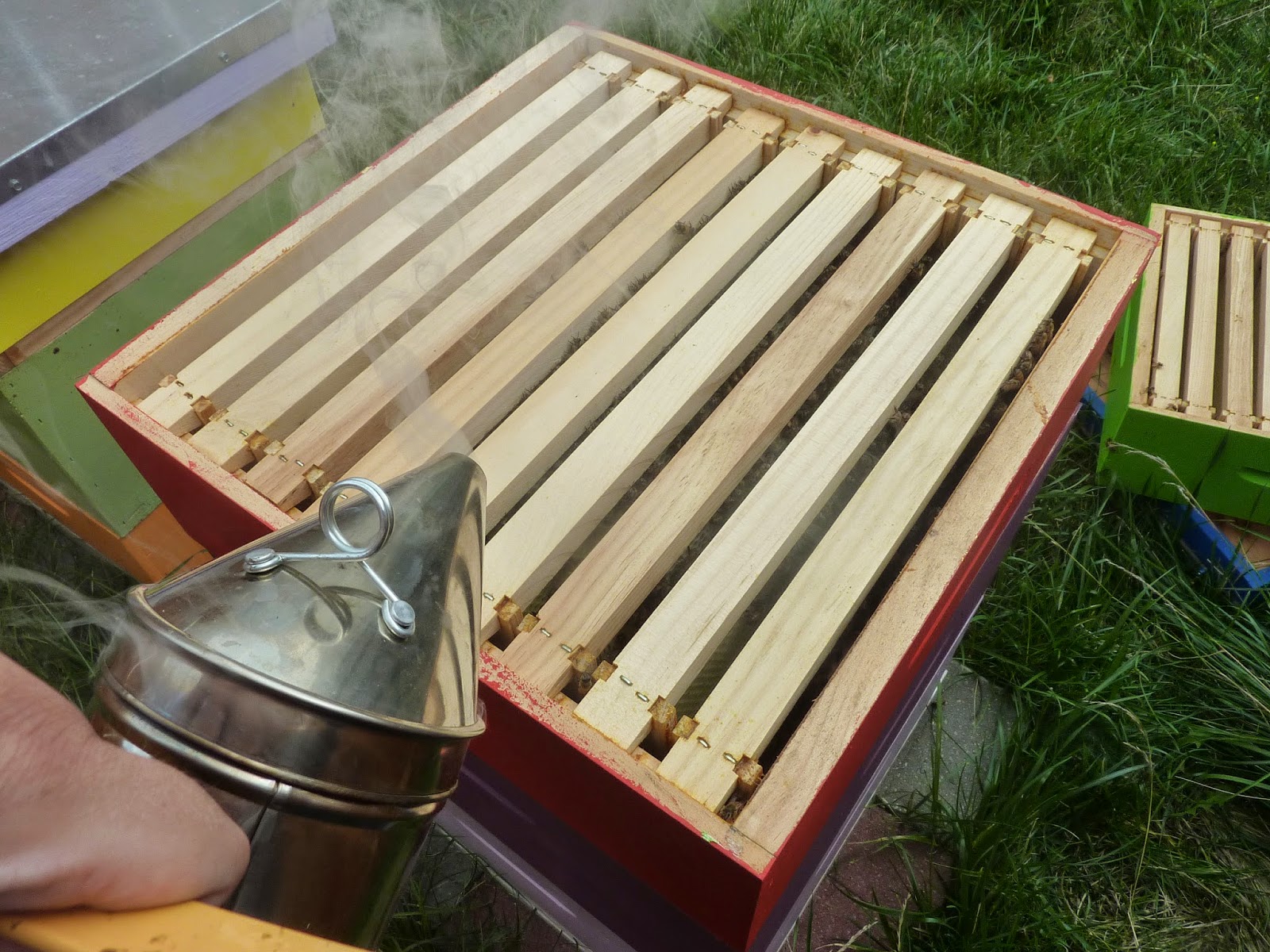
We smoked Lavender, and opened it up, and my Dad immediately stated that they still didn't have a queen. He could tell by the loud buzzing sound coming from the hive. Most likely, the eggs I gave them were too old, and they couldn't raise a viable queen from any of them. While inspecting, we determined the colony wasn't using the original super that I started them in when I caught the swarm, so we removed that.

Then we smoked Rose to search for some new eggs to put another frame into Lavender and repeat the process again. However, without us realizing it, the weather began to turn cloudy and overcast. We took off the supers (the lowest super is full of honey BTW, my Dad predicted around 25 lbs!) and inspected just about every frame in the top hive body. None of the frames had anything but capped brood and honey. Before we had time to inspect the lower hive body, my Dad was stung 4 or 5 times, and we decided to close it up and come back again another day. As we closed up both hives, we moved the empty super that was on the bottom of Lavender, and put it on top of Rose, so Rose is up to 3 supers.

Within the next 2 days, we decided to order a new queen from Walter T. Kelley. We drove down to Clarkson, Kentucky on Monday, August 11, 2014 to pick it up and put the queen's cage into the hive that evening when we got back.

August 14, 2014
We inspected Lavender again to check on the queen's cage, and as soon as we opened it, the bees were much more settled than the last inspection. My Dad could tell instantly by the sound they made that they were more comfortable because they had a queen. It was a subtle change, and I wouldn't have noticed the change in their sound if he hadn't pointed it out. The workers in the hive had eaten far enough through the candy so they would have had her out by the end of that day. But we didn't want to have to go back in to remove the empty queen's cage later, because the weather was getting unpredictable. And we wanted to remove the cage as soon as possible to prevent them from building burr comb. So my Dad removed the screen from the queen's cage and released her and the attendants into the hive. I am kicking myself as I write this, because I should have taken some pictures during the last few days, especially of this task. The queen left her cage, and first climbed around on my Dad's hand before climbing down onto a frame.

At the same time, since we had the smoker burning, we checked Rose again, and the bees are actively working on the third super that we put on just 3 days before.

August 15, 2014
The bees in Rose were soooo active, I was amazed how many bees were foraging (coming in and out). My Dad predicted that the hive probably brought in at least 2 pounds of honey, just that day! Good thing we put the 3rd super on. I also was happy that we have enough fence around the hives to force the bees to fly up before flying to the flowers where they're collecting nectar, because that many bees flying in and out with a low flight pattern would make it hard for us to even be in our yard on that busy of a day.

August 16, 2014
Lavender was long over due for a refill of syrup in the feeder, and I added a 4th super to Rose. Exciting times in our backyard lately.

Still to come in the next few weeks and months:
~ Confirmation of eggs from the new queen in Lavender - it's getting late in the season, so they really need to take off fast and get to increasing their worker numbers to fill 2 hive bodies for the winter.
~ Taking supers off Rose to extract honey. I never thought this would happen the first season, but it's a whole new step for me, since I never learned this part from my Dad in person. He's coming for another short visit though, for a wedding that's a few hours away, so I am going to try to get what I can done before he gets here.
~ Winterizing - getting the hives ready for winter is important, and every beekeeper has different ideas for how to do it.
~ Assisting and mentoring a first time beekeeper

Tuesday, July 29, 2014

A New Young Queen?

We'll find out if Lavender has one soon.

After a discussion with my Dad on Sunday 7/20, I weighed the numbers, or the dates, I suppose. Under the best possible circumstances, if I bought a new queen for the hive, I might be able to have a new laying queen settle into Lavender by at most a week sooner than if I provided the colony with eggs from Rose.

My Dad explained that a laying worker complicates things, and the bees in the colony might not accept a new queen. If they raise a queen, it's almost a guarantee that she will be accepted and cared for. So, with that potential setback on the back of my mind, I decided to switch some frames between the hives to give Lavender a frame containing fresh eggs and also a frame of brood (young bees) from Rose.

Remember the photos from my last post? I've included one here, but I've circled in red where you can see larger cells that have been drawn out differently:


These are the queen cells that the colony has been drawing out in hopes that one of the eggs laid by the laying worker would be fertile and grow a new queen. Instead, when the bees realized it was simply another drone, they stopped drawing it out (a true queen cell should be even longer - I'll try to take another picture the next time I have the hive open, if I can find one).

The bees will take a fresh egg (or most likely at least a couple, maybe more) and move them into these drawn out cells. They'll finish drawing them out to the right length, and feed the larva royal jelly and these will become supersedure cells. A swarm cell  is done in a similar fashion, but wouldn't usually be found in the middle of the frame. It would be found hanging from the bottom of a frame.

I was concerned that I would create more work for the bees, asking them to grow additional supersedure cells, given that there were already several built inside some of the frames. However, my Dad explained that the bees will choose the egg (or eggs) they feel are best for raising a queen, and move them to the cells that have already been drawn out.

Lavender has been slowly declining, with more bees dying off, and only drones hatching in the hive. So I also pulled one frame of brood from Rose that had bees ready to hatch from it. In fact, I could see the new bees beginning to emerge from a few of the cells. This will help to keep the colony alive a couple more weeks until the new queen is laying.

For now, I can see some bees are out foraging when I watched the outside today, and that's a good sign. When I checked the syrup level in the feeder this evening, there were a lot more bees in the top working around the jar, and this seems to also be a very good sign.

As I am typing this post, it's been about 9 or 10 days since I switched the frames to help Lavender again. In a couple more days, I'll check the hive again, and hopefully have good news about it's status.

Sunday, July 20, 2014

Laying Worker Bee

Just when I think I've got something figured out, and the little hive, Lavender, can do her thing and just grow and improve, we hit a bump in the road. But I can honestly say that I'm learning something new every step of the way. I have previously heard of and read about a laying worker, but never imagined I'd encounter one so soon in my beekeeping career. A laying worker bee is generally found when a colony doesn't have a queen, and also doesn't have any fresh eggs to raise a new queen among the brood (supersedure cell).

While inspecting both hives today, I found the larger hive, Rose, to be going along great and doing well. Just plugging along and starting to build out and fill the lower super.

At the request of an old friend, I took my camera with me, to snap a few pictures. Here are some general photos I took. The first is a picture, of the super that Rose is currently working on. In the background, you can see the other super that goes on top of this one.


This next picture is one of the super frames that the hive is working on. The whiter section of the frame is where they've built out some comb, and the yellower tinted areas are empty foundation.


In this next photo, you can see in the top right hand corner where the comb (described above) is more visible. Some of the bees in this photo are building out more comb, and the ones with their heads in the cells are slowly filling the cells with nectar.

This is just a close up shot of the bees that were clustered around the bottom of the super frame.


I'm glad I had the camera with me, and I owe my friend a big thanks. If I hadn't taken it with me to take some general photos I would not have been able to document and explain what to look for to "diagnose" a laying worker.

In this case, I may never know why they no longer have a queen. It may be that she died. She may have been an old queen that came with the swarm from their original hive, and queens are only good for a couple years, usually 3 at the most. She may have been deemed not good enough by the colony, and they killed her, but whatever the reason, I don't believe they have a queen anymore.

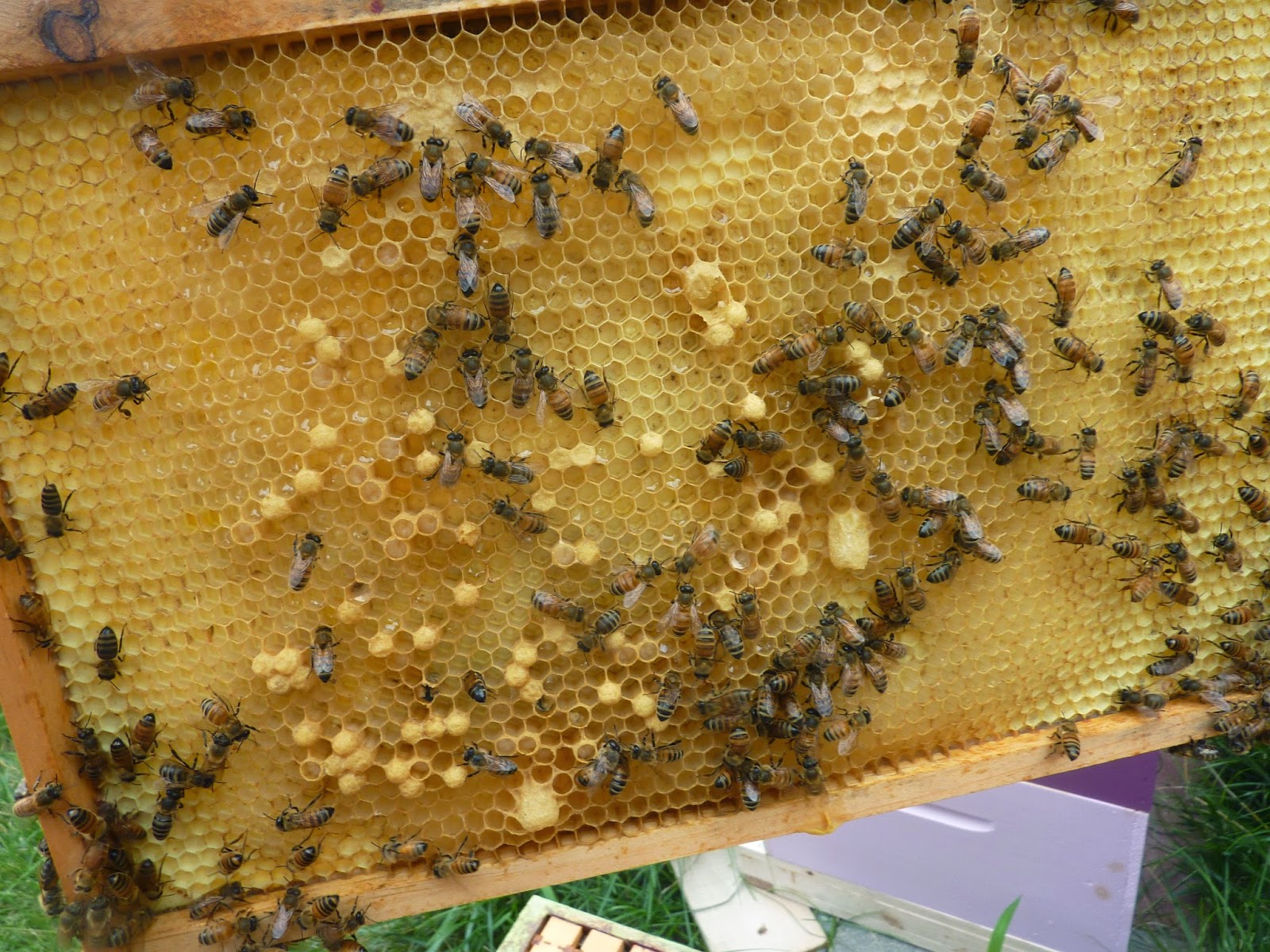
Two weeks ago, when I gave Lavender a frame of brood from Rose, I checked and saw fresh eggs laid in Lavender's hive body, and celebrated it a bit, thinking the queen was settling in well. I now know better, because any new brood cells (and there aren't too many) are all drone cells. A laying worker doesn't have the physical ability to breed and carry sperm for fertilizing her eggs, but she can still lay the eggs. Unfertilized eggs will only ever grow into drone bees. So this colony is slowly going to die off without a queen.

In the following pictures, you can see the very spotty brood (not much has been laid) and each cell that's capped is rounded up a bit (rounded, capped cells are drones & flat, capped cells are workers).


I was able to come to this conclusion after a discussion with my Dad about what I saw (he was the one who suggested if all the capped brood is drone, that it's almost definitely a laying worker). His first suggestion is to give them a frame of capped brood and a frame of fresh eggs from Rose. Since talking with him on the phone, I haven't gone back out to switch the frames yet. I'm debating whether or not to buy a new queen from Walter T Kelley for the colony, to get a queen in there and laying sooner. I'm sad that this smaller hive has had such a huge setback, and now torn about how to fix it. At any rate, I can't wait very long to decide on a course of action, so I'll have another update soon.

Hope all of you readers enjoy the extra pictures in this post :)

Wednesday, July 9, 2014

A Little Help from One Hive to Another

July 4, 2014
I opened up both hives, to assess their status, and make sure Rose wasn't expanding any faster and requiring anymore supers. I also wanted to check on the activity level of Lavender to assess how much they were working in the hive body and moving out of the lower super.

Rose was doing very well, and seemed to have just started working in the 1st super just a bit. They have done a very nice job of filling the frames in the hive bodies, but just to make sure they would completely fill the outermost frames, I flipped them. If you imagine all 10 frames numbered from 1 to 10, I pulled out 1 and 10 and flipped them so the outside faces of each frame are now turned in.

Lavender still seems to have very low numbers, and as I look back at the dates here in my records, I know it will still take some time to build up the brood (and for the brood to hatch). So in an effort to give them a boost, I traded a frame from Lavender with a frame from Rose. I looked through all the frames in the upper hive body of Rose, and chose what appeared to have the largest amount of capped brood, though still only about 50% of the cells were capped. I knocked off all but half a dozen bees or so, and placed it into the middle of Lavender. Then I took an empty, foundation frame from the outside of Lavender, and placed it on the outside of Rose. I did this at the recommendation of my Dad, and he has assured me Rose will barely notice. I hope I also helped Lavender instead of creating more work for them.

July 7, 2014
I checked on the syrup level in Lavender when it was almost dark in the evening, and their jar was nearly empty. I took them a new jar, and now I'm working on a new batch of syrup, since I'm just about out (and the syrup I have been using has gotten a bit too old). It was made in early May, so it has lasted a while in my refrigerator.

As a side note, when starting a new hive, and through the early spring if you're feeding a weak hive that's wintered over, you feed them a syrup that is a 1:1 ratio of sugar to water. The recipe that I got from my Dad is as follows:

Bring 20 cups of water to a full rolling boil in a large covered pot. Turn off the heat and add a 10 lb bag of sugar. Stir the whole pot until all the sugar has dissolved. Then add 1/8 tsp of sea salt. When the liquid has cooled, my Dad then adds maybe about a tsp of lemon juice.

I split this recipe in half, and also leave out the extra steps of sea salt and lemon juice. He said they aren't crucial, but he likes to add them for various reasons. And now that I've reminded myself of the recipe, I'm off to heat some water and make another batch.

Edit:
I forgot to mention, this syrup recipe makes approximately 2 gallons (I think just a bit less than 2) and requires a VERY large pot. I don't have a pot large enough in my kitchen, so that's why I split the recipe in half. Also, if you only have one or two hives, and you won't use up the syrup relatively soon (within a few days, or maybe if you push it, a week at most) refrigerate the syrup in jugs (recycled milk or water jugs) to store it for longer. My husband makes a lot of homebrew, and enjoys an occasional growler from various local breweries, so I borrow his empty, clean growlers to store syrup.

Supers!

June 25, 2014
I finally decided to follow another blogger's lead, and name my hives after flowers. I've chosen Rose for the larger, older hive that I started from a package in May. I added two supers to the top of Rose, and took the feeder off. I laughed about it after, comparing it to taking off the training wheels from a bicycle for a child :)

The name I've picked for the smaller hive that was started from a swarm is Lavender. Because I already had my smoker lit, and was out there sweating like crazy anyway, I decided to check for eggs and see how the smaller colony was doing. In the hive body, that I only added 5 days ago, there were already eggs and larva of varying ages. This means the queen is doing her job and they are moving right along into the larger space. I didn't feed them any more syrup, because they still had 1/2 a jar.

In other news, I've been reading more about Colony Collapse Disorder (CCD) and what real research has actually been published about it's causes. It seems like CCD is now used interchangeably to describe the decline in bee colonies overall. Enough people around the country, celebrities, politicians, and the like, are taking notice, and making this news topic "sexier." CCD is a term used a lot in the media, and it gets the attention of average citizens around the country.

This article has a lot of the basics and some of the details covered well:
http://www.takepart.com/feature/2014/06/20/what-is-killing-bees

I also find this link very interesting. The President has finally taken notice and decided the US should start to do something about the problem.

Hope everyone has a terrific 4th of July and finds a festive way to celebrate our Nation's Independence!